Search News  

News

All the latest news relevant to the feed industry
Submit Feed News + Press Releases

Top


Bookmark and Share this Page:

Top

In the News - Images

Have your say - Feed Discussion Forum

Feed Manufacturing News

Feed News from Africa

FG plans increase agricultural production, exports

VANGUARD
12/12/2007

Federal Government has disclosed plans to increase agricultural production in the country to enhance service delivery in terms of food availability, accessibility and export.

Dr. Abba Sayyadi Ruman, Minister of Agriculture and Water Resources made the disclosure while speaking at the opening ceremony at the 6th Nigeria Economic Summit Group (NESG) Agricultural Summit in Abuja.

Tags · · · ·

• Continue reading • Comments (0) 12.12.2007. 22:54

Ghana’s equipment can detect bird flu - Vet

08/05/2007

The Veterinary Services Department of the Ministry of Food and Agriculture has assured the public that Ghana has the necessary equipment to test avian influenza virus.

"The Veterinary Services has an Avian Influenza Diagnostic Laboratory, which was refurbished in April 2006 by the United States Agency for International Development (USAID) and the Noguchi Memorial Institute for Medical Research (NMIMR), which has an advanced facility - Polymerase Chain Reaction (PCR) - to detect genre of the virus," Dr Enoch Boye-Mensah Koney, Director of Veterinary Services told the GNA.

He was refuting claims by the Tema Municipal Poultry and Livestock Farmers Association and Farmers' Union, who doubt the authenticity of the reported outbreak of the H5NI Bird flu in the municipality.

Dr Koney explained that the specimen that was collected from the farm in Tema was first sent to the Accra Veterinary Services Laboratory, then to Noguchi and U.S. Naval Medical Research Unit No. 3, Cairo, Egypt for confirmation.

Tags ·

• Continue reading • Comments (0) 08.05.2007. 13:42

CDA surveys feedlots for fattening cattle

06/01/2007

The Capital Development Authority (CDA) has surveyed 54 plots of land out of the envisaged 300 in Michese, Zuzu and Nala villages in the municipality for feedlots on which high-quality cattle would be raised.

CDA Director for Planning Emson Adamson Mwanamtwa said here yesterday that the ambitious plan seeks to involve smallholder cattle keepers in a cattle-fattening scheme.

When complete, the feedlots would cover 2,000 hectares of pastureland in which Smallholder pastoralists would use the feedlots to fatten cattle for slaughter.

The scheme would produce 250 high-value cattle daily for Dodoma Modern Abattoir. The abattoir, an ultra-modern facility with capacity to slaughter 250 head of cattle daily, handles only 80 bulls a day at the moment.

The cattle the abattoir slaughters mainly for municipal consumption, however, are mostly lean and underfed. Mr Mwanamtwa said when successful, the scheme would see smallholder cattle breeders raising small herds of high-quality bulls in the feedlots.

The 300 or more feedlots, all of which would be in close proximity to the Dodoma abattoir, would have a bull population running into several thousands. The scheme would also establish a cattle feed mill, high-quality pasture farms and a bull centre with an artificial insemination department.

The scheme has delighted both the CDA Board of Directors and the Ministry of Livestock Development. Mr Mwanamtwa said the ministry has promised to send experts to help in drawing strategies for the capital intensive scheme.

He said the mill would process animal feeds including cotton and sunflower seed cakes, molasses and husks from maize and other grains. At the moment, improved pasture is under cultivation near the ultra-modern abattoir at Kizota secondary cattle market.

The area is also a holding ground for cattle earmarked for slaughter. The scheme would also benefit from advice given by the Mbande Pasture Improvement Research Centre on the fringes of the municipality. The smallholder cattle keepers would draw capital from a loaning system.


The CDA director for planning said the feedlots would vary in size but the smallest would cover four hectares. He said a South African meat company, Prime Meat, has been roped in to help train the smallholder breeders to fatten cattle in the feedlots.
The CDA has prepared the project in conjunction with the Tanzania Livestock Marketing Project and the Mpwapwa Livestock Production Research Institute. It takes the cue from the highly successful Mtibwa fattening farms where about 500 cattle are raised.

CDA has allotted four hectares to Prime Meat so that they start a demonstration feedlot that would be used to enlighten smallholder keepers on better animal husbandry methods. Dodoma Region has potential for livestock production. The scheme is also seen as a poverty reduction strategy.

Mr Mwanamtwa said intensive and extensive breeding of high-value cattle could help cut back on poverty. Cattle keepers would adopt the establishment of feedlots, fattening farms and ranches as new methods of pasture management, he said.

He said the abattoir faces a sustainability threat - the challenge of ensuring a continuous supply of 250 beef cattle daily militating. The other challenge lies in the need to produce for slaughter the required standards of cattle in terms of weight -- with the lightest bull weighing 350 kilos.

The quality of meat produced at the abattoir rarely attains international quality standards. This being the case, the beef production sector does not compete favourably at international markets and the backlash is that beef is often imported leading to high expenses and loss of foreign currency.


Tags ·

• Comments (0) 06.01.2007. 12:30

New school of thought on fish

By Ernest Harsch
BUSINESS DAY
28/12/2006

AT THE base of the Zomba plateau in southern Malawi, more and more villagers are digging ponds to raise fish. James Chitonya previously grew maize, with meagre returns. But since he began fish farming (or aquaculture) several years ago, he has earned enough from fish sales to replace his grass hut with a house that has electricity and an iron-sheet roof, pay school fees for his children and buy some livestock.

A few thousand kilometres away, in Nianing, on Senegal's coast, hundreds of women clean the 50 tons of fish caught annually by kinsfolk who venture into the Atlantic in canoes. The fish is sold to residents or to companies for export to Asia. Concerned that overfishing was beginning to deplete the stocks of offshore fish, Nianing's fishers and fish processors welcomed support from the government and a Japanese aid agency to improve management of fishing, the village's economic mainstay. Since the project began, the value of Nianing's total fish output has increased by almost half.

Initiatives such as these must be replicated across Africa if the continent is to harness the promise of its fisheries to strengthen economies, reduce poverty and improve food security and nutrition, argue promoters of the New Partnership for Africa's Development (Nepad). Although fishing in much of rural Africa tends to be overshadowed by agriculture and stock raising, it is not a marginal sector. Fishing provides direct incomes for about 10-million people, half of whom are women, and contributes to the food supply of 200-million more.


The WorldFish Centre, a research institute headquartered in Malaysia, reports that Africans rely on fish for an average of 22% of their consumption of animal protein. In some countries, the rate is as high as 70%. The poor rely on fish more than others, because it is often the most affordable source of protein.

African fish exports increased notably during the 1980s and 1990s. By 2001 they reached $2,7bn, about 5% of the total global trade of $56bn. According to the United Nations Food and Agriculture Organisation (FAO), fish products constitute more than 10% of the value of exports in 11 African countries.

But under current fishing practices, Africa's marine and inland fisheries are reaching their limits. Too many fish are being caught, so stocks are dwindling. Daniel Pauly, a researcher at the University of British Columbia in Canada, estimates that with the tripling of fishing activity in northwest Africa since the 1970s, the amount of fish in deep waters has fallen by a quarter. Off West Africa, deep-water fish stocks have declined by half.

A Nepad action plan for the development of African fisheries and aquaculture observes that during the 1980s and 1990s, fish caught in marine and inland waters increased steadily, rising to a yearly average of 7,3-million tons. But output has stagnated since then, reaching only 6,8-million tons in 2002.

Increasingly governments are implementing policies that limit catches and allow fish stocks to replenish themselves. Other options include investing in fish-processing enterprises, cold storage units and marketing facilities that will increase incomes and minimise losses, thereby easing the economic pressure to catch so many fish.

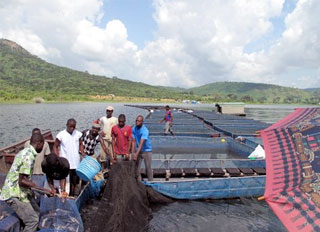
Improving the efficiency and sustainability of Africa's marine and inland fisheries will help boost overall production to some extent. But they alone will not be able to meet the continent's growing domestic demand for fish nor increase exports on a significant scale. The Nepad plan therefore singles out aquaculture as the sector with the greatest potential for expansion.

Fish farming, practiced in Asia for hundreds of years, was introduced into Africa more than a century ago with modest impact. Only in the past decade has aquaculture begun to take hold, with overall production rising from 80000 tons in 1990 to more than 530000 tons in 2003. But this is still only a small fraction of Africa's total fish output.

Even in countries where production is still low, as in Mozambique, the sector is winning greater attention. Fish farming, says Isabel Omar, an aquaculture expert in Mozambique's fisheries ministry, "plays an important role in the socioeconomic development of the country" by improving people's diets through the provision of low-cost protein, creating jobs and enhancing rural incomes.

According to studies by the FAO, about 9,2-million km(31% of the land area) of sub-Saharan Africa is suitable for smallholder fish farming. If the yields achieved in recent projects can be maintained on a wide scale, devoting only 0,5% of this area to aquaculture would be sufficient to meet a third of Africa's additional demand for fish by 2010.

If aquaculture output can grow by an average of 10% a year, argues a technical paper distributed at the August 2005 Fish for All summit, then Africa will be able to reach about 3-million tons over the next 15 years. Such growth could create at least 5-million additional jobs, help feed millions more and yield another $50m to $100m in export revenues.


Tags ·

• Comments (1) 01.01.2007. 03:01

Zanzibar engrossed in bird flu scare

By Issa Yussuf
THE GUARDIAN
05/12/2006

Zanzibar bird flu task force has incinerated 40 chickens in their continuing bid to check the threat of bird flu in the Isles.

"We seized a chicken consignment imported from Tanzania Mainland," Dr Kassim Gharib from the task force said.

He said people suspected to have imported the chicks escaped arrest but said police were still looking for them.

Dr Gharib blamed the Zanzibar business community for continuing to import poultry products despite an indefinite ban imposed last year.

Under Zanzibar law, any person convicted of importing poultry products risks a minimum sentence of six months.


The task force is part of Zanzibar's Ministry of Agriculture and Livestock's efforts to combat the disease in the island.

Between April and October this year, the task force confiscated and destroyed hundreds of eggs and chickens smuggled into Zanzibar.

"Since bird flu has not been controlled in many countries, the ban of poultry products from outside Zanzibar remains," Dr Gharib said.

Apart from the on going awareness campaign about bird flu, Zanzibar has intensified efforts to control the importation of poultry products and pork, including those from Tanzania Mainland.

The deadly avian flu has been found in several African countries. The poultry industry in Asia and a number of European countries have been ravaged by the disease, which has killed a number of people.


Tags ·

• Comments (0) 05.12.2006. 12:30