Specific energy use in grinding refers to the amount of electrical energy consumed by a grinding mill per unit mass of material processed to a given target particle size, typically expressed as kilowatt-hours per tonne. It is a more precise efficiency measure than total mill power draw alone, since it accounts for both the energy used and the actual throughput achieved, allowing meaningful comparison between different operating conditions, equipment configurations or even different mills.
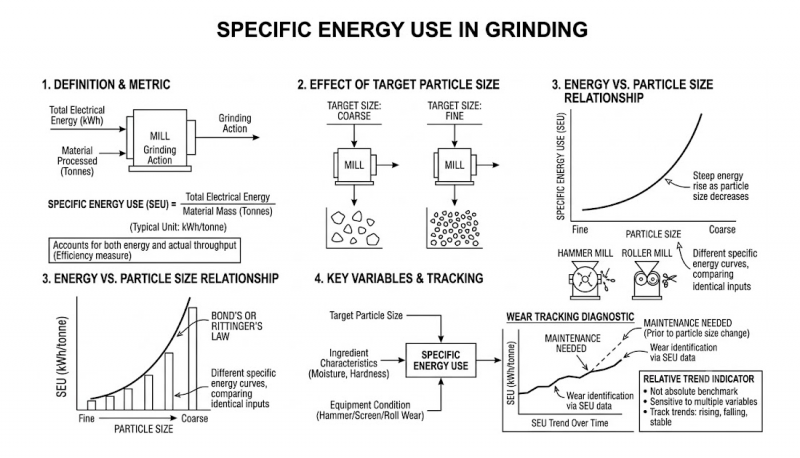
Specific energy use in grinding increases as target particle size decreases, since finer grinding requires more impact or shear events per unit of material to achieve the smaller particle size — this relationship means that even modest changes in target particle size specification can have a disproportionate effect on grinding energy costs across a feed mill's total production volume.
This relationship between particle size and energy is often approximated using established size-reduction theory (such as Bond's or Rittinger's law, originally developed in the broader minerals processing field), which provides a general framework for understanding why energy demand rises steeply as target particle size becomes progressively finer, though real-world feed milling results are also strongly influenced by ingredient-specific factors that idealized theoretical models do not fully capture.
Ingredient characteristics such as moisture content and hardness, along with equipment condition — particularly hammer, screen or roll wear — also significantly affect specific energy use, which is why tracking this metric over time is a useful diagnostic tool for identifying when grinding equipment maintenance is needed, often before any obvious change in finished particle size becomes apparent through routine sieve testing alone.
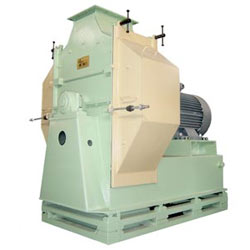
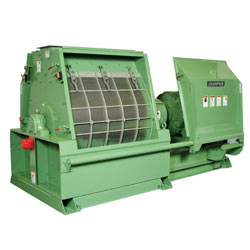
Comparing specific energy use between a hammer mill and a roller mill processing the same ingredient to a similar target particle size frequently shows a meaningful difference in energy demand between the two technologies, which is one of the practical factors feed mills weigh when deciding which grinding technology to invest in for new capacity, alongside considerations like resulting particle size distribution and capital cost.
Because specific energy use is sensitive to so many interacting variables, most feed mills treat it as a relative, trend-based indicator rather than an absolute benchmark to be matched against published figures from other mills or equipment suppliers, focusing on whether their own specific energy use is rising, falling or stable over time as ingredients, equipment condition and production mix evolve.

 Esbjerg O, Denmark
 Bandırma, Turkey
 Crawfordsville, United States of America