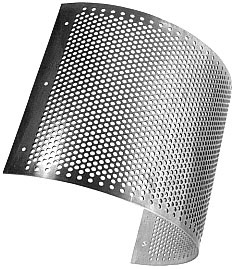
Hammer mill screens (also referred to as perforated plates) are the perforated metal plates that form a curved barrier around the lower portion of the hammer mill's grinding chamber, through which ground material must pass to exit the mill. Hole diameter in the screen is the single largest factor determining the maximum particle size of the ground product, since material continues to be impacted by the rotating hammers until it is small enough to pass through the screen perforations.
Screens are available in a wide range of hole sizes and patterns to suit different target particle sizes for different species and feed types — fine particle sizes are often desired for poultry or fish feed to improve digestibility and pellet binding, while coarser particle sizes may be preferred for some ruminant feeding applications.
Screen hole pattern, in addition to simple diameter, affects both grinding capacity and resulting particle size distribution: round holes are the most common pattern, but some screen designs use other hole shapes or arrangements intended to influence airflow through the mill or to affect how readily ground material passes through versus continuing to be impacted, depending on the specific grinding outcome desired.
Screen open area — the total percentage of the screen surface occupied by holes rather than solid metal — affects both throughput capacity and screen structural strength, similar to the analogous tradeoff in pellet die hole pattern design; more open area generally allows higher grinding capacity but reduces the screen's mechanical strength and service life under the continuous impact stress of hammer mill operation.
Screens wear and develop enlarged or distorted holes over time due to constant abrasive contact with both the material being ground and the hammers themselves, gradually shifting the particle size distribution of the ground product coarser; screen replacement on a planned schedule, rather than waiting for visible failure, helps maintain consistent grind quality.
Screen changeover is typically a more frequent maintenance task than die replacement in a comparable mill, since screens generally wear faster than dies given their continuous direct exposure to both the abrasive ingredient stream and the impact of the hammers themselves, and many mills keep a stock of screens in commonly used hole sizes specifically to minimize downtime when a screen change is needed.

 Foshan, China