The hammer mill rotor is the rotating shaft assembly inside a hammer mill to which the hammers (beaters) are attached, typically via pivot pins that allow each hammer to swing freely. The rotor spins at high speed — often in the range of 3,000 to 4,000 rpm depending on mill design — and it is the kinetic energy delivered by the spinning hammers, driven by the rotor, that impacts and shatters ingredients against the mill's screens and breaker plates to achieve particle size reduction.
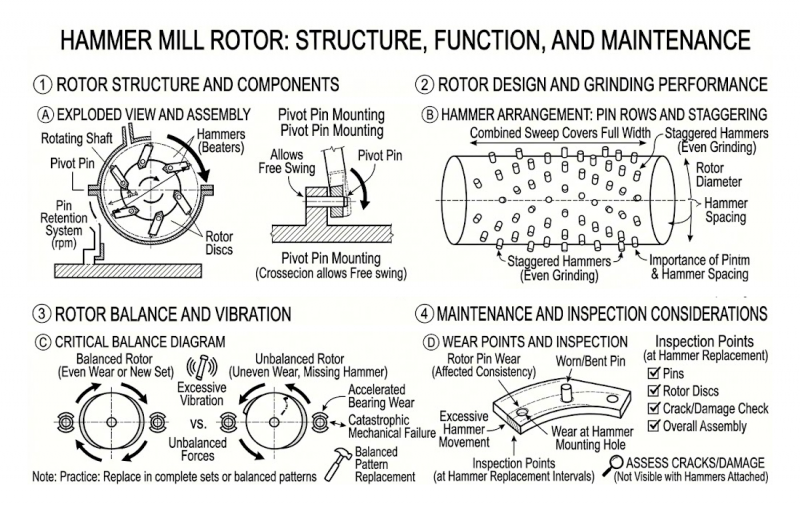
Rotor design directly affects grinding performance: the number of hammer rows, hammer spacing around the rotor, and rotor diameter all influence tip speed at a given rotational speed, which in turn affects both grinding efficiency and the resulting particle size distribution of the ground product.
Most rotors use a multi-row pin arrangement, with hammers staggered between rows so that the combined sweep of all hammers covers the full width of the grinding chamber evenly, rather than leaving gaps that allow unground material to pass through without being struck. The number of pin rows and hammers per row varies by mill size and is typically specified by the manufacturer to balance grinding intensity against rotor weight and drive power requirements.
Rotor balance is critical to hammer mill operation — an unbalanced rotor, whether from uneven hammer wear or a missing/broken hammer, causes excessive vibration that accelerates bearing wear and can lead to catastrophic mechanical failure if not corrected promptly. Many mills follow a practice of replacing hammers in complete sets or in a balanced pattern around the rotor, rather than individually as they wear, specifically to avoid introducing an imbalance partway through a hammer's service life.
Rotor pin wear is a secondary but still significant maintenance consideration, since the pins themselves — not just the hammers mounted on them — are subject to wear and impact stress over time, and a worn or bent pin can allow excessive hammer movement that affects grinding consistency and accelerates wear at the hammer mounting hole.
Beyond routine wear, rotor and pin condition is typically assessed during scheduled hammer replacement intervals, since this is a convenient point to inspect pins, rotor discs and the overall rotor assembly for cracking, wear or other damage that would not necessarily be visible without removing the hammers.

 Foshan, China