Grinding efficiency in feed milling describes how effectively a grinding machine — most commonly a hammer mill or roller mill — converts the mechanical energy supplied to it into the particle size reduction achieved, typically expressed in terms of energy consumed (kWh) per tonne of material ground to a given target particle size. Higher grinding efficiency means less energy is required to achieve the same degree of size reduction.
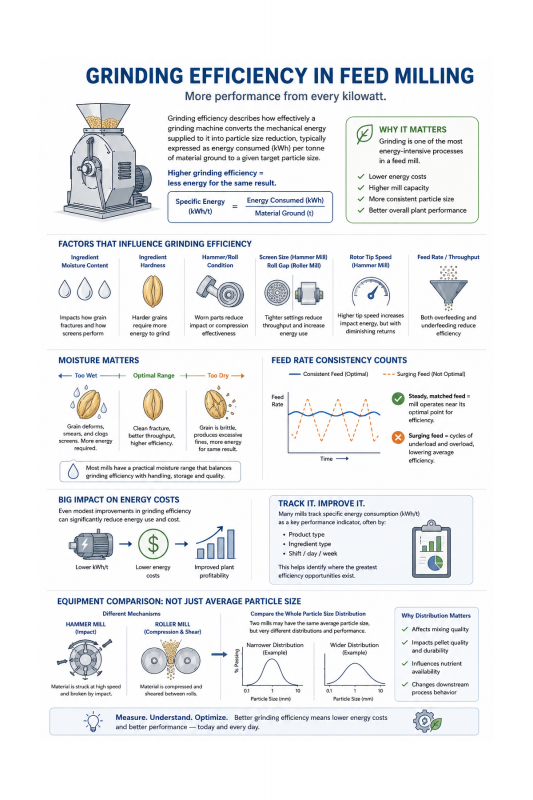
A wide range of factors influence grinding efficiency, including the moisture content and hardness of the ingredient being ground, hammer or roll condition, screen or roll gap selection, rotor tip speed, and how well the mill is fed — both overfeeding and underfeeding a hammer mill can reduce efficiency compared to operating at its optimal throughput rate.
Ingredient moisture content has a particularly strong effect on grinding efficiency: grain that is too moist tends to deform rather than fracture cleanly under impact, smearing rather than shattering and clogging screens more readily, while overly dry grain can be brittle in ways that produce excessive fines rather than the target particle size — most mills have a practical moisture range for incoming grain that balances grinding efficiency against other handling and storage considerations.
Feed rate consistency is another underappreciated factor: a hammer mill fed in surges, rather than at a steady, matched rate, tends to alternate between periods of underutilized grinding capacity and periods of overload, both of which reduce average grinding efficiency compared to maintaining a steady feed rate matched to the mill's optimal operating point.
Because grinding is typically one of the most energy-intensive single processes in a feed mill, even modest improvements in grinding efficiency can have a meaningful impact on overall plant energy costs, which is why many mills track specific energy consumption in grinding as a key performance indicator, often broken down by product or ingredient type to identify where the greatest efficiency opportunities exist.
Comparing grinding efficiency across different equipment types is not always straightforward, since hammer mills and roller mills achieve size reduction through fundamentally different mechanisms (impact versus compression and shear), and a fair efficiency comparison generally needs to account for the resulting particle size distribution achieved, not just the average particle size, since a roller mill and hammer mill producing the same average particle size may still differ meaningfully in distribution width and therefore in downstream processing behavior.
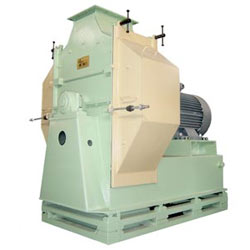

 Crawfordsville, United States of America
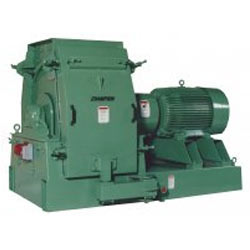
 Foshan, China