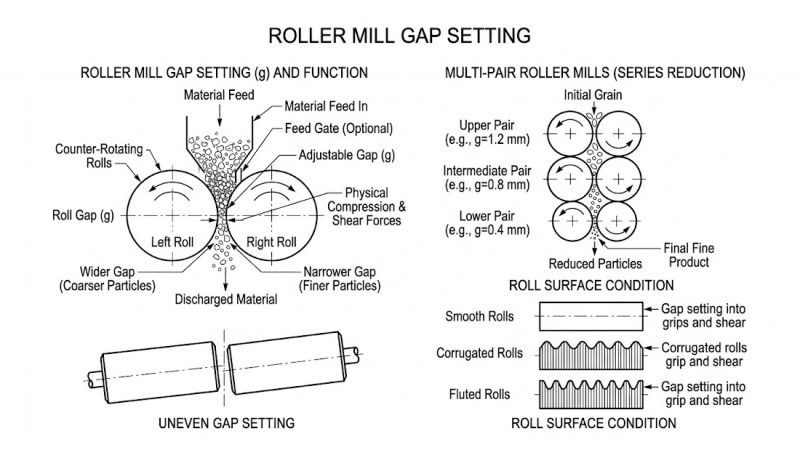
The roller mill gap setting is the adjustable clearance between the two (or more) rolls in a roller mill, through which grain or other ingredients pass to be crushed or flaked rather than impacted as in a hammer mill. The gap setting is the primary variable controlling the resulting particle size: a wider gap produces coarser particles, while a narrower gap produces finer particles, with the relationship governed by the physical compression and shear forces applied as material passes between the rolls.
Because roller mills crush rather than impact ingredients, they generally produce a more uniform particle size distribution with fewer very fine particles or dust compared to hammer mills processing the same ingredient to a similar average particle size, which is one reason roller mills are often preferred for applications where minimizing fines is important.
Multi-pair roller mills, using two or more sets of rolls in series with progressively narrower gaps, are commonly used where a greater degree of size reduction is needed than a single roll pair can efficiently achieve, with each successive roll pair refining the particle size further while distributing the overall grinding work across multiple stages rather than concentrating it at a single, more aggressively set gap.
Roll surface condition — whether smooth, corrugated or fluted — also interacts with gap setting to determine grinding outcome, since textured roll surfaces grip and shear material differently than smooth rolls, and a worn roll surface losing its original texture can change grinding performance at the same nominal gap setting compared to when the rolls were new.
Roll gap must be adjusted to suit both the ingredient being processed and the target particle size, and uneven gap setting across the width of the rolls — whether from wear, misalignment or mechanical issues — results in inconsistent particle size across the product stream, which can affect downstream processing and finished feed quality.
Gap adjustment mechanisms typically allow fine incremental control, often via a calibrated adjustment screw or hydraulic positioning system on larger mills, and operators generally verify actual resulting particle size through periodic sieve testing rather than relying solely on the gap setting indicator, since roll wear over time can cause the actual effective gap to differ slightly from the nominal setting shown on the adjustment mechanism.

 Jiaozuo City, China
 Crawfordsville, United States of America
 Bandırma, Turkey