Retention time refers to the average length of time that material spends within a particular piece of processing equipment — most commonly discussed in the context of a conditioner ahead of a pellet mill, or a cooler following it. In a conditioner, retention time determines how long mash is exposed to steam, heat and moisture before reaching the pellet mill, directly affecting the degree of starch gelatinization and overall conditioning achieved.
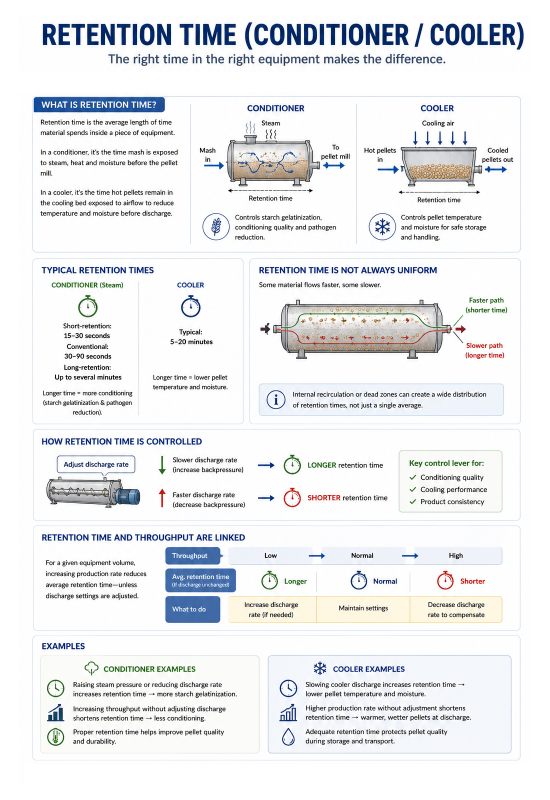
In a cooler, retention time (often referred to as residence time in this context) determines how long hot pellets remain within the cooling bed exposed to cooling airflow, which must be sufficient to reduce both pellet temperature and moisture to safe levels for storage before the pellets are discharged for further handling or bagging.
Typical conditioner retention times in conventional steam conditioning range from as little as 15 to 30 seconds in simple, short-retention designs, up to several minutes in long-retention conditioners specifically designed to maximize starch gelatinization or achieve a higher degree of pathogen reduction than shorter conditioning allows.
Retention time is not always uniform for every particle passing through a given piece of equipment — some material may pass through more quickly than the calculated average (often material traveling along the most direct path through the equipment), while other material may be retained longer, particularly in equipment with internal recirculation or dead zones, meaning that actual retention time distribution can be considerably wider than a single average figure suggests.
Retention time in both conditioners and coolers is generally controlled by adjusting the rate at which material is discharged from the equipment — a slower discharge rate increases retention time for a given equipment volume, while a faster discharge rate reduces it, making discharge rate control a key operational lever for managing both conditioning quality and cooling performance.
Because retention time interacts so directly with throughput rate (for a fixed equipment volume, increasing production rate necessarily reduces average retention time unless the discharge mechanism is specifically adjusted to compensate), production rate changes often require corresponding adjustments to conditioner or cooler discharge settings to maintain consistent conditioning quality or cooling performance as throughput varies.