Pellet durability index (PDI) is a standardized laboratory test used to quantify the mechanical durability of pellets — essentially, how well pellets withstand the handling, conveying and transport stresses they encounter between leaving the pellet mill and being consumed by the animal, without breaking down into fine particles. The most widely used method involves tumbling a sample of pellets in a specified test device for a fixed time, then measuring the percentage of the original pellet mass that remains as intact pellets afterward.
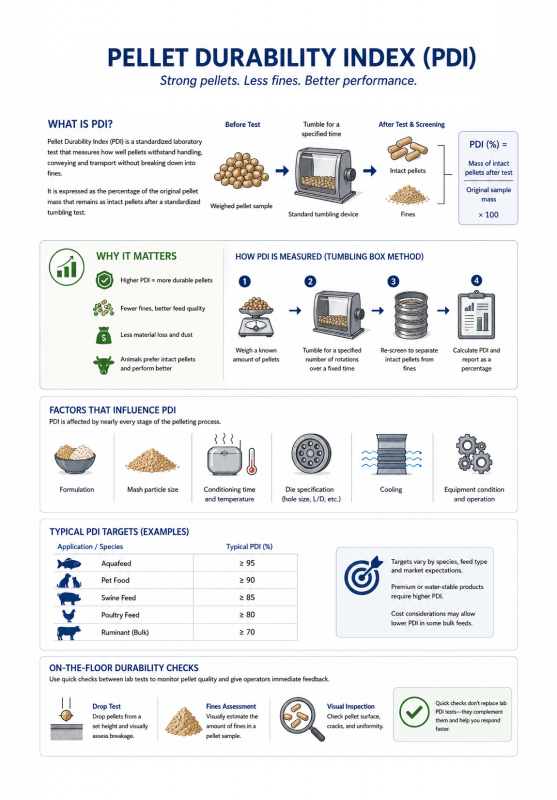
A higher PDI value indicates a more durable pellet that will generate fewer fines during subsequent handling, which is generally desirable both for finished feed quality (animals tend to prefer and perform better on intact pellets rather than fines) and for minimizing material loss and dust generation throughout the distribution chain.
Several standardized test methods exist for measuring pellet durability, with the most common using a tumbling box apparatus that subjects a weighed pellet sample to a specified number of rotations over a fixed time, after which the sample is re-screened to separate intact pellets from generated fines; results are typically reported as a percentage representing the proportion of the original sample mass remaining as whole pellets.
PDI is influenced by nearly every stage of the pelleting process — formulation, particle size of the ground mash, conditioning time and temperature, die specification, and cooling — making it one of the most commonly tracked quality control measurements in pellet feed production, and a key metric used when troubleshooting pellet quality issues.
Target PDI values vary considerably by species, feed type and market expectation: aquafeed and pet food applications often demand very high durability given the additional handling stresses of water contact or premium packaging expectations, while some bulk livestock feed applications may tolerate somewhat lower PDI values if cost considerations outweigh the marginal benefit of further durability improvement.
Because PDI testing requires laboratory equipment and a discrete sample rather than providing instantaneous, continuous feedback, many mills supplement periodic PDI testing with simpler, faster on-the-floor durability checks (such as a basic drop test or visual fines assessment) to give operators more immediate feedback between formal laboratory test results.

 Esbjerg O, Denmark
 Yangzhou, China