Conditioning (steam conditioning) is the process of treating ground mash with steam, heat and moisture for a controlled period of time immediately before it enters the pellet mill's die and roll assembly, and is one of the most influential single steps in determining finished pellet quality. Steam delivers both heat and moisture efficiently into the mash, softening starch and protein structures so the material binds together more readily under the pressure applied during pelleting.
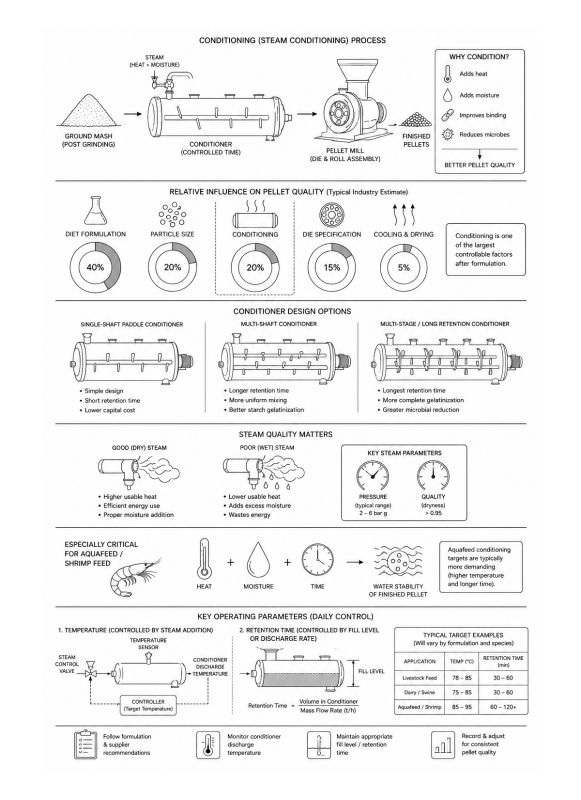
The relative contribution of different factors to overall pellet quality has been estimated by some industry sources as roughly 40% diet formulation, 20% particle size, 20% conditioning, 15% die specification and 5% cooling and drying — placing conditioning as one of the largest controllable factors once a formulation has already been set, which is why most modern pellet mills are fitted with one or more conditioners ahead of the press.
Conditioner design varies from simple single-shaft paddle conditioners providing a relatively short retention time, to longer, multi-shaft or multi-stage conditioners (sometimes called "long retention" conditioners) designed to hold mash for a longer period at controlled temperature, allowing more complete starch gelatinization and microbial reduction than a shorter-retention design can achieve at the same temperature.
Steam quality — specifically, steam that is properly dry (not carrying excessive condensed water droplets) and at appropriate pressure — directly affects conditioning performance, since wet, low-quality steam delivers less usable heat per unit of steam consumed and can introduce excess moisture into the mash without providing the corresponding heating benefit dry steam would deliver, making boiler performance and steam line condition relevant considerations even though they are physically separate from the conditioner itself.
Conditioning is especially critical in aquafeed and shrimp feed production, where good water stability of the finished pellet is essential, and the combination of heat, moisture and time achieved during conditioning directly affects how well the finished pellet resists breaking down once introduced into water — aquafeed conditioning specifications are frequently more demanding (in terms of target temperature and retention time) than typical livestock feed conditioning.
Conditioning temperature and retention time are usually treated as the two primary tunable parameters during day-to-day operation, with operators adjusting steam addition rate to hit a target discharge temperature from the conditioner, and adjusting conditioner fill level or discharge rate to influence retention time, generally guided by formulation-specific targets developed through a combination of supplier recommendations and the mill's own production experience.