Die holes (also referred to as die perforations) are the individual channels drilled or formed through a pellet die ring, through which mash is compressed and extruded to form pellets. The diameter of the die holes is the primary determinant of finished pellet diameter, and feed mills typically stock dies in a range of common hole sizes to suit different species and product types, from small-diameter dies for fish or poultry starter feeds to larger holes for cattle or large livestock pellets.
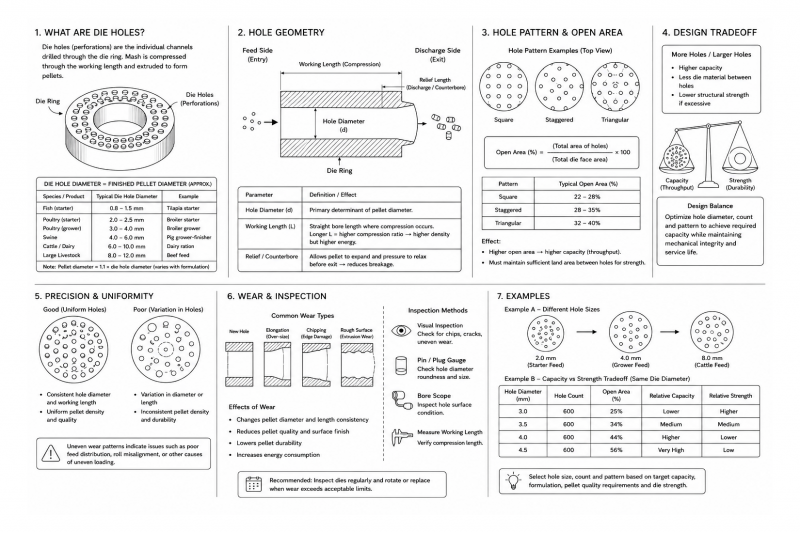
Beyond diameter, the working length of each hole — the depth of straight bore through which compression actually occurs, distinct from any relief or counterbore at the discharge end — determines the compression ratio applied to the mash, directly affecting pellet density, durability and the energy required to extrude material through the die.
Hole manufacturing precision matters significantly to pellet quality consistency: holes that vary even slightly in diameter or working length across the same die face will produce pellets of inconsistent density and durability, which is why die manufacturing tolerances are typically held quite tight, and why a die showing uneven wear patterns across its face is often a sign that something — whether feed distribution, roll alignment or another factor — is causing certain sections of the die to be worked harder than others.
Hole pattern and spacing across the die surface also affect overall die capacity and the proportion of the die surface actively used for pelleting; dies with a higher percentage of open hole area relative to the total die surface generally allow higher throughput for a given die diameter, provided structural integrity of the die is maintained.
The relationship between hole count, hole diameter and die structural strength is a key design tradeoff: increasing the number or size of holes to boost capacity reduces the amount of solid die material remaining between holes, which can compromise the die's ability to withstand the mechanical stresses of continuous operation if taken too far, making die hole pattern design a balance between throughput capacity and mechanical durability.
Periodic inspection of die holes for elongation, chipping or surface roughening is a standard part of pellet mill quality control, since these forms of wear directly affect both pellet dimensional consistency and the surface finish of the finished pellet, with rougher or worn hole surfaces generally producing pellets with more visible surface flaws and reduced overall quality appearance even if core durability remains acceptable.

 Crawfordsville, United States of America
 Yangzhou, China