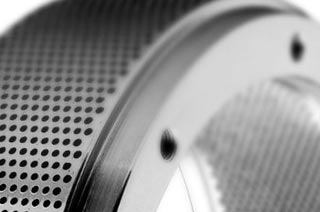
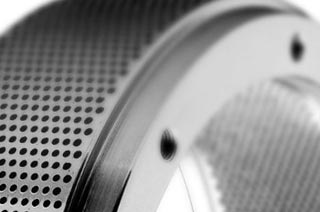
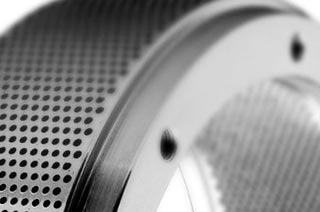
A die clamp (or die holder) is the mechanical fixture used to secure the pellet die ring firmly in position within the pellet mill, ensuring the die remains correctly seated and aligned with the roll assembly during operation. Because the die is subjected to significant rotational forces and the mechanical stress of continuous compression during pelleting, a secure, properly torqued clamping system is essential both for product quality and operator safety.
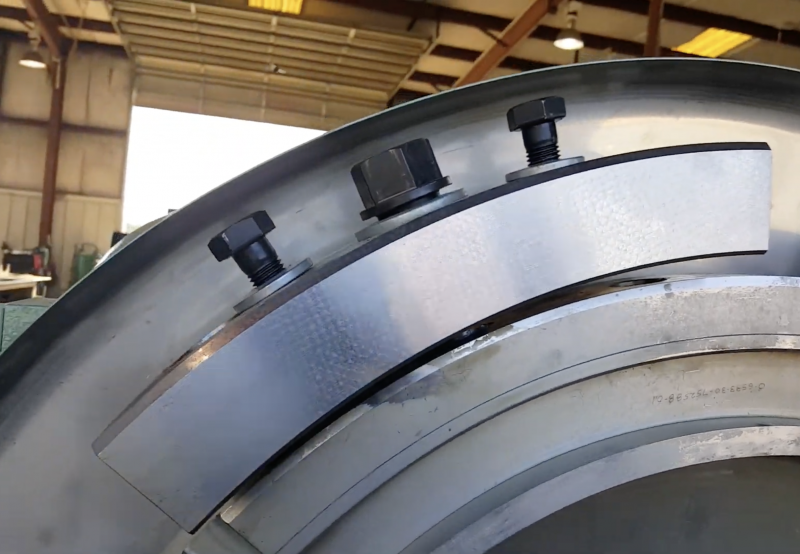
Die clamps must allow for relatively quick die changes, since switching dies to accommodate different pellet sizes or formulations is a routine maintenance task in most feed mills, while still providing the clamping force needed to prevent any movement of the die during operation, which could otherwise cause severe damage to the pellet mill or pose a serious safety hazard.
Clamp designs vary between pellet mill manufacturers, ranging from multiple individual bolted clamp segments distributed around the die circumference to more integrated hydraulic or mechanical clamping rings designed to apply even pressure across the full die mounting surface, with the specific design chosen reflecting a balance between changeover speed, clamping force uniformity and mechanical simplicity.
Correct clamp torque procedure typically specifies not just the target torque value but also the sequence in which clamping bolts or segments should be tightened, since tightening in the wrong order can introduce uneven stress around the die circumference, potentially causing the die to seat slightly out of true alignment even if every individual clamp point reaches its specified torque value.
Clamp and mounting hardware wear, along with correct torque procedures during die changes, are standard items in pellet mill preventive maintenance programs, since improperly secured dies are a known cause of catastrophic pellet mill failures, and most manufacturers provide explicit torque specifications and changeover procedures specifically to reduce this risk.
Some mills incorporate a documented die-change checklist or sign-off procedure as part of their safety program, given the consequences of an improperly secured die, treating die changeover as a higher-risk maintenance task warranting more formal verification than routine wear-part replacement elsewhere in the plant.

 Foshan, China

 Crawfordsville, United States of America