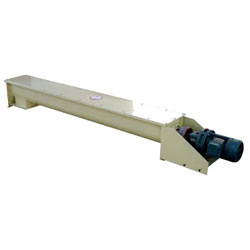
A screw conveyor (also called an auger conveyor) moves bulk material horizontally, at an incline, or vertically over short distances using a rotating helical screw (flighting) enclosed within a stationary trough or tube. As the screw turns, material is pushed along its length, making screw conveyors a simple, enclosed and relatively low-cost way to transfer grain, meal, additives or finished feed between processing stages.
Screw conveyors are widely used in feed mills for metering ingredients into a mixer, transferring material from a hopper to a grinder, or moving product short distances between machines where a fully enclosed, dust-tight path is needed. Their throughput is governed largely by screw diameter, pitch (the spacing between flights) and rotational speed.
Pitch is typically described relative to screw diameter — a "standard pitch" screw has flight spacing roughly equal to its diameter, while shorter-pitch screws move material more slowly per revolution but with greater control, which is why short-pitch or variable-pitch screws are often chosen specifically for metering duties rather than bulk transfer.
Beyond simple transfer, screw conveyors are also used as live bottom agitators beneath bins and hoppers to assist material flow, and in some mixer designs the mixing action itself is provided by one or more screws (ribbon or paddle screw mixers) rather than a separate paddle or ribbon agitator, blurring the line between conveying and mixing equipment in certain applications.
Because the screw runs in direct contact with the material being conveyed, screw conveyors are prone to wear, particularly when handling abrasive ingredients, and the flighting or full screw assembly is a common spare part in feed mill maintenance programs. Bearing and shaft seal wear at the drive end and the far (tail) end of the screw are also routine inspection points, since seal failure at a screw conveyor's end bearing is a common source of product leakage or contamination ingress.
Screw conveyors are less suited than belt or pneumatic systems for moving large volumes over long distances, since power consumption per tonne increases significantly with conveying distance, but they excel at controlled, low-speed metering applications and at handling sticky, fine, or otherwise difficult-to-convey materials that would not flow well on an open belt.

 Foshan, China