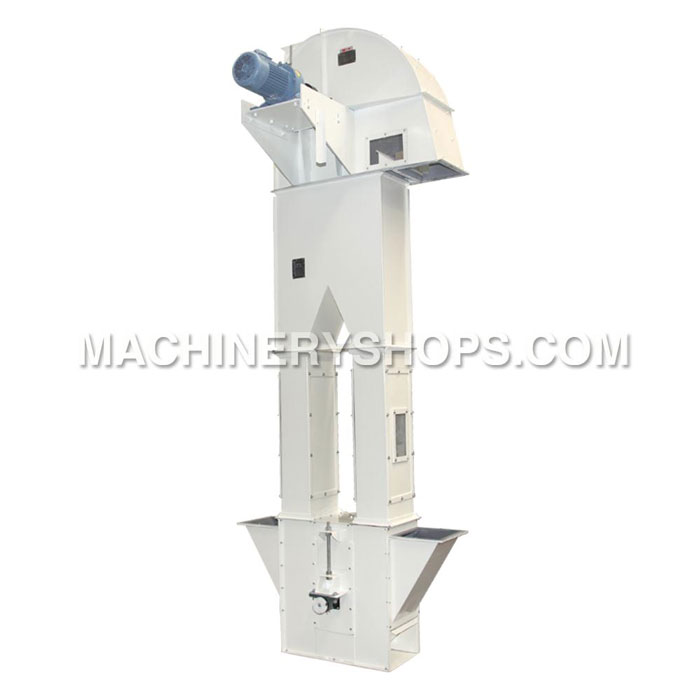
A bucket elevator is a vertical conveying machine used to lift bulk materials — grain, meal, pellets or finished feed — from one level of a feed mill to another. It consists of a series of buckets mounted on a continuous belt or chain that travels between a head pulley at the top and a boot (or tail) pulley at the bottom, enclosed within a casing to contain dust and protect the material from contamination.
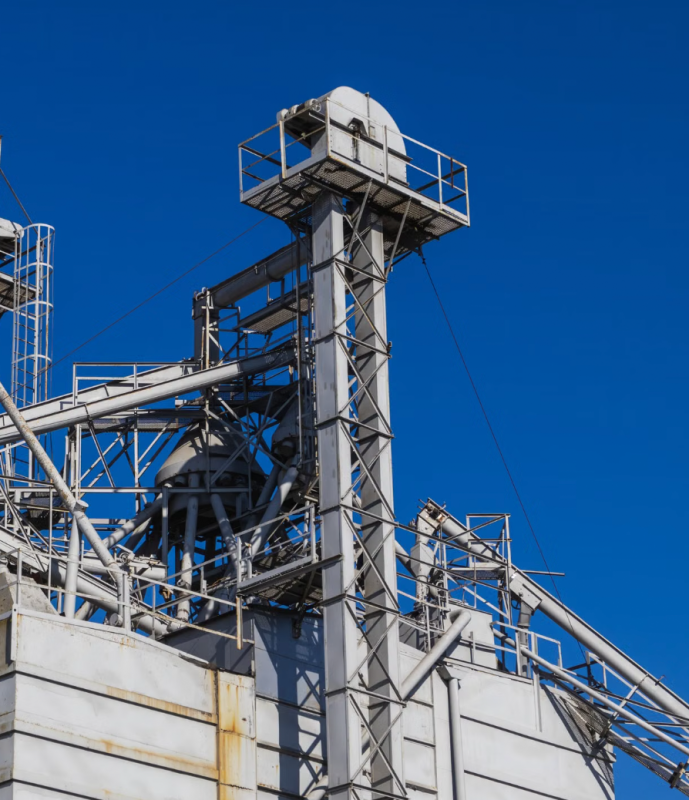
Material is loaded into the buckets at the boot section, carried upward along the leg, and discharged at the head as the buckets pass over the top pulley and invert. Bucket elevators are valued in feed mills because they can move material to significant heights with a relatively small footprint, using less horsepower per ton than equivalent pneumatic conveying systems for dense, free-flowing products.
Two common configurations exist: centrifugal discharge elevators, which rely on the buckets being thrown outward at speed to empty their contents, and continuous (or gravity) discharge elevators, which run more slowly and use the shape of adjacent buckets to guide material out smoothly — better suited to fragile pellets that could be damaged by centrifugal force.
Elevator capacity is determined by bucket size, bucket spacing along the belt or chain, and operating speed, with manufacturers typically publishing capacity ratings in tonnes per hour for a given combination of these factors and a given elevator height. Selecting an elevator for a new installation generally starts from the required throughput rate and the vertical lift needed, then works backward to the appropriate bucket and drive specification.
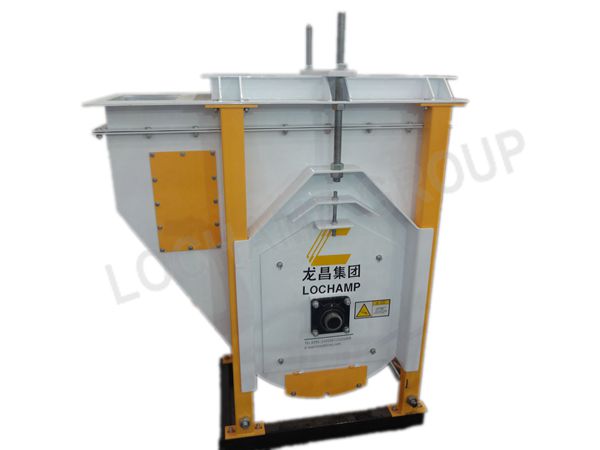
Maintenance typically focuses on belt or chain tension, bucket wear and alignment, and boot clearance, since a poorly adjusted boot section is one of the most common causes of spillage and bucket damage in a feed mill leg. Belt or chain stretch over time requires periodic re-tensioning, and most elevator designs include a take-up arrangement at the boot to allow this adjustment without dismantling the entire leg.
Common operational problems include slipping (where the belt or chain moves but the buckets do not advance at the expected rate, usually from insufficient tension or a worn drive pulley lagging), boot plugging (where material accumulates faster than it can be carried away, often due to overfeeding or a partial blockage further up the leg), and bucket damage from oversized foreign material entering with the product stream. Inline magnets installed ahead of the elevator boot are a common safeguard against the latter.
Because the elevator leg is fully enclosed, it also serves as a natural point to monitor for dust accumulation and to install explosion relief or isolation devices where the conveyed material presents a combustible dust risk, making bucket elevators a regular feature in feed mill safety reviews as well as routine mechanical maintenance programs.

 Bandırma, Turkey
 Jiaozuo City, China