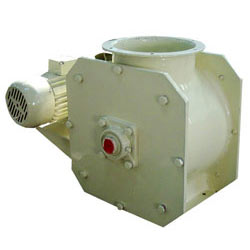
A rotary airlock (also called a rotary valve or rotary feeder) is a mechanical device that allows material to pass from a higher-pressure or atmospheric zone into a pneumatic conveying line or process vessel operating under vacuum or pressure, without allowing significant air to leak through with it. It consists of a rotor with several pockets turning inside a close-tolerance housing; material drops into each pocket at the top and is carried around to discharge at the bottom, while the rotor's close fit to the housing limits air bypass.
In feed mills, rotary airlocks are most commonly found at the base of cyclones, bag filters and silos feeding into pneumatic conveying lines, where they meter material into the airstream while sealing the system against unwanted air ingress that would reduce conveying efficiency.
Rotor pocket design varies by application: open-end rotors allow material to pass straight through the pocket, suited to free-flowing granular materials, while blind (closed-end) rotors have a solid back wall to each pocket, preventing material from being pushed straight through under pressure differential and instead forcing it to follow the rotor's full rotation before discharge — generally preferred where a tighter air seal is required.
Airlock sizing is based on the required material throughput and the rotor's pocket volume per revolution, with rotational speed adjusted (often via a variable-speed drive) to match the desired feed rate into the downstream pneumatic line; running an airlock too fast for the available pocket fill can reduce metering accuracy, while running it too slowly limits maximum achievable throughput.
Performance depends heavily on the clearance between the rotor and housing, which increases with wear over time, gradually reducing the airlock's sealing capability. As clearance grows, more air bypasses through the airlock rather than being used productively to convey material, which can show up as reduced conveying line performance even though the airlock itself continues to meter material more or less normally.
Rotor and housing wear parts are common consumables in feed mill maintenance, particularly when conveying abrasive materials such as mineral premixes or screenings. Many operators track airlock performance indirectly through conveying line pressure or vacuum readings, since a gradual drift in these readings — even without any obvious airlock malfunction — often points to increasing rotor clearance as the underlying cause.

 Foshan, China