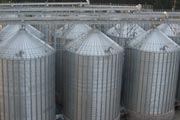
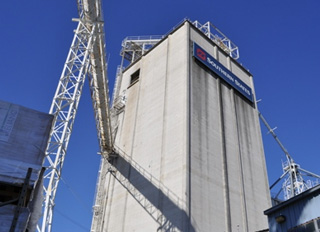
Feed flowability describes how readily a feed ingredient or finished product flows under gravity or mechanical assistance through bins, hoppers, chutes and conveying equipment, without bridging, ratholing or otherwise obstructing material flow. Poor flowability is a common and costly operational problem in feed mills, leading to inconsistent ingredient delivery, equipment downtime, and in some cases the need for manual intervention to clear blocked equipment.
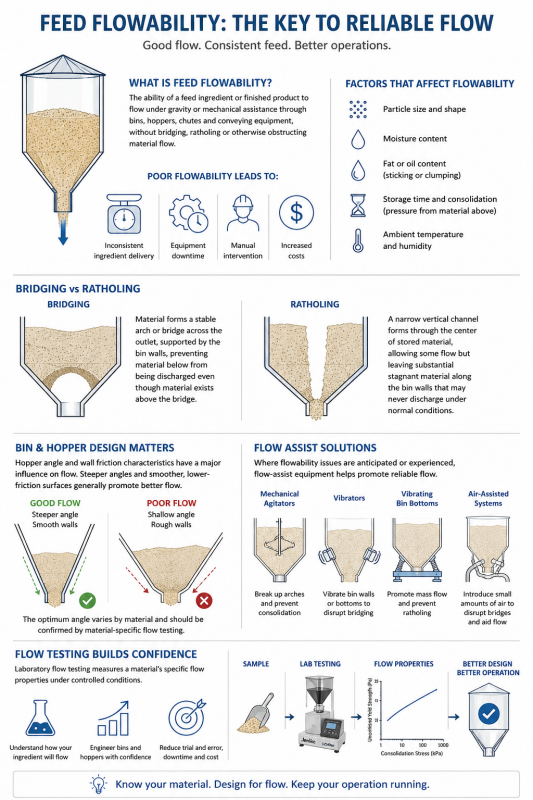
Flowability is influenced by particle size and shape, moisture content, fat or oil content (which can cause sticking or clumping), storage time and consolidation under the weight of material above, and ambient temperature and humidity, which can affect how readily some ingredients absorb moisture and lose their free-flowing characteristics.
Bridging occurs when material forms a stable arch or bridge across a bin or hopper outlet, supported by the bin walls, that prevents material below the bridge from being discharged even though the bin is not actually empty above the bridge point, while ratholing describes a related but distinct phenomenon where a narrow vertical channel forms through the center of stored material, allowing some flow but leaving substantial stagnant material along the bin walls that may never discharge under normal operating conditions.
Bin and hopper design — particularly hopper angle and wall friction characteristics relative to the specific material being stored — has a major influence on whether a given ingredient flows reliably under gravity alone, with steeper hopper angles and smoother, lower-friction wall surfaces generally promoting better flow, though the specific angle required to guarantee reliable flow varies considerably between different materials and must often be determined through material-specific flow property testing rather than assumed from general rules of thumb.
Anti-bridging devices, vibrators or other flow-assist equipment are often installed where flowability issues are anticipated or have been experienced with a particular ingredient or storage configuration, ranging from simple mechanical agitators and vibrating bin bottoms to air-assisted systems that introduce small amounts of compressed air into the stored material to disrupt bridging and promote more reliable flow.
Flow testing using specialized laboratory instruments that measure a material's specific flow properties under controlled conditions allows hopper and bin designs to be engineered with more confidence for difficult-to-handle ingredients, rather than relying purely on trial and error or general industry experience, particularly for new or unusual ingredients where no established handling history yet exists at a given facility.
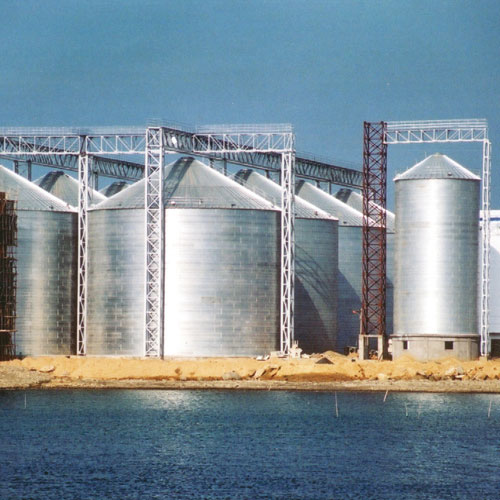

 Yangzhou, China