Angle of repose is the steepest angle, measured from horizontal, at which a pile of granular or bulk material can stand without the slope collapsing or flowing further under its own weight — a fundamental physical property of any bulk material that directly informs decisions about bin and hopper design, stockpile management, and equipment intended to convey or contain that material.
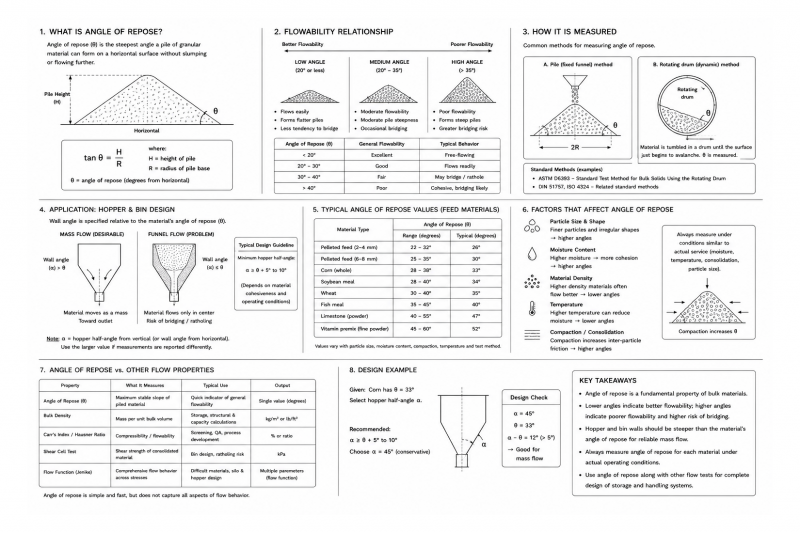
Materials with a low angle of repose flow relatively easily and form flatter piles, generally indicating good flowability and fewer handling complications, while materials with a high angle of repose form steeper, more stable piles, often correlating with poorer flowability and a greater tendency toward bridging or other flow obstruction problems in storage and handling equipment.
Angle of repose is typically measured by allowing a sample of the material to flow freely onto a flat surface (or through a standardized funnel apparatus) and measuring the resulting angle of the formed pile relative to horizontal, with standardized test methods existing to ensure measurements are comparable across different materials, operators or testing facilities.
Hopper and bin wall angles are commonly specified relative to a material's angle of repose, with the general engineering principle being that hopper walls steeper than the material's angle of repose promote reliable mass flow, while walls at a shallower angle than the material's angle of repose risk material adhering to and building up on the walls rather than flowing freely toward the outlet.
Different feed ingredients and finished products exhibit quite different angle of repose values — free-flowing pellets typically have a notably lower angle of repose than fine, cohesive powders or meals, which is one reason hopper and bin designs optimized for handling pelleted product are not always equally suitable for handling mash or fine ingredient storage without modification.
Angle of repose is closely related to, but distinct from, the more comprehensive flow property testing sometimes used for difficult-to-handle materials, since angle of repose provides a useful, relatively quick single-number indicator of general flowability, while full flow property testing characterizes a material's behavior under a wider range of conditions relevant to more demanding or unusual storage and handling design challenges.

 Yangzhou, China