Airflow in feed cooling refers to the volume rate of air passed through a bed of hot pellets in a cooler, typically expressed in cubic meters per minute per tonne of pellets cooled (or equivalent imperial units), and is one of the primary variables determining how effectively and quickly pellets are cooled and dried after leaving the pellet mill. Sufficient airflow is needed to remove both the heat and the residual moisture from steam conditioning that pellets carry as they exit the pellet mill.
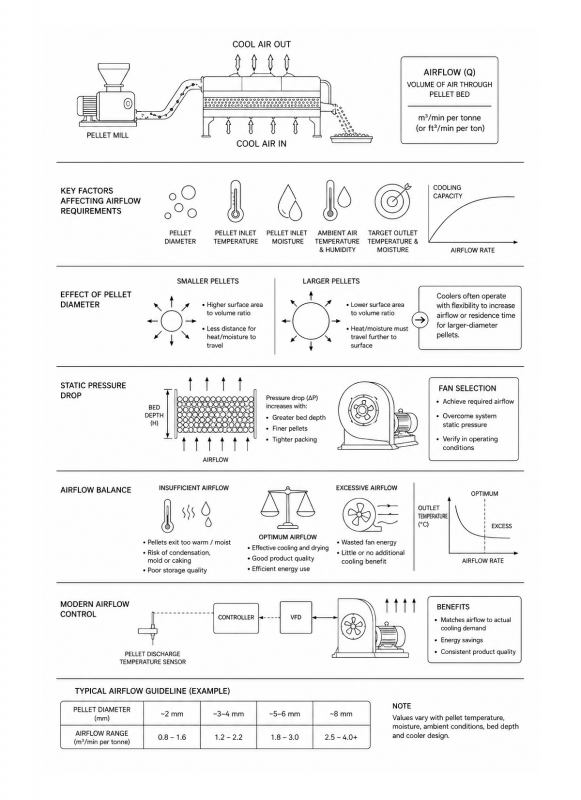
Airflow requirements depend on factors including pellet diameter, the temperature and moisture of pellets entering the cooler, ambient air temperature and humidity, and the target final pellet temperature and moisture — coolers are generally sized to handle worst-case conditions such as hot, humid ambient weather, which reduces the cooling capacity of a given airflow rate compared to cooler, drier conditions.
Pellet diameter has a particularly significant effect on required airflow, since larger-diameter pellets have a smaller surface-area-to-volume ratio than smaller pellets, meaning heat and moisture must travel further from the pellet core to reach the cooling airstream — for this reason, coolers handling a range of pellet sizes are often designed or operated with some flexibility to increase airflow or residence time specifically when running larger-diameter products.
Static pressure drop across the pellet bed — the resistance the bed of pellets presents to airflow passing through it — increases with bed depth and with finer or more tightly packed product, and cooler fan selection must account for this resistance to ensure the design airflow rate is actually achieved in practice rather than simply specified on paper without verifying the fan can overcome the actual operating static pressure.
Insufficient airflow results in pellets leaving the cooler too warm or too moist, risking condensation, mold growth or caking during subsequent storage, while excessive airflow beyond what is needed wastes fan energy without providing meaningful additional cooling benefit, making correct airflow sizing and control an important balance in cooler design and operation.
Some modern cooler installations incorporate variable-speed fan control linked to pellet discharge temperature feedback, automatically adjusting airflow to match actual cooling demand rather than running at a fixed rate sized for worst-case conditions at all times, which can offer meaningful energy savings during periods when ambient conditions or production rate make less than maximum airflow sufficient to achieve target cooling performance.

 Crawfordsville, United States of America
 Shang hai, China