The cooling process immediately follows pelleting and is the operational stage in which hot, moist pellets discharged from the pellet mill are cooled and partially dried by passing ambient or conditioned air through a bed of pellets within a cooler, typically a counterflow or horizontal design. Pellets exiting the pellet mill can be hot enough and moist enough that they would be susceptible to mold growth, caking or structural damage if moved directly to storage without cooling.
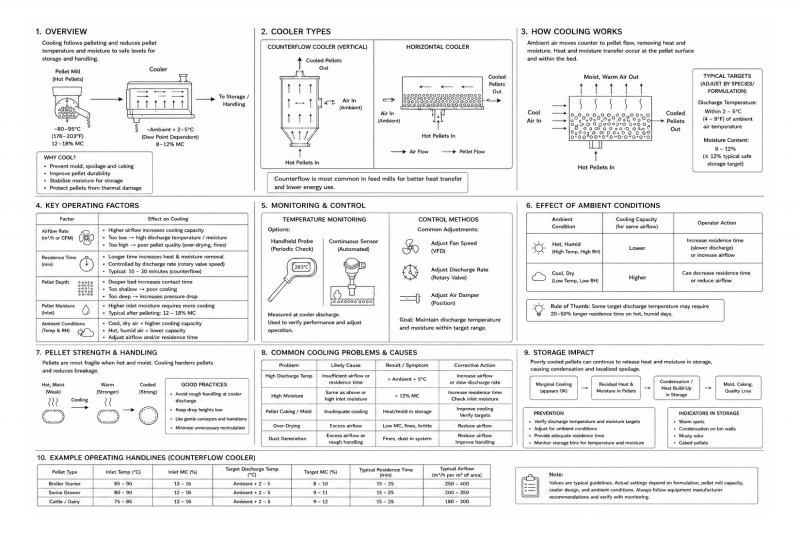
Cooling operation performance is governed by the combination of airflow rate and residence time within the cooler, both of which must be sufficient to bring pellet temperature down to within a few degrees of ambient and reduce moisture to a safe target level for storage, with insufficient cooling representing one of the more common causes of in-storage feed quality problems.
Operators typically monitor cooling operation through pellet discharge temperature measurement, either using a handheld probe thermometer for periodic spot checks or, in more automated installations, a continuous temperature sensor positioned at the cooler discharge feeding back to the plant control system for real-time monitoring and even automatic adjustment of cooler discharge rate.
Ambient weather conditions have a meaningful effect on cooling operation performance from day to day, since hot, humid ambient air provides less cooling capacity for a given airflow rate than cool, dry air — many mills find that achieving the same target pellet discharge temperature requires adjusting cooler residence time (typically by slowing the discharge rate) during particularly hot or humid weather compared to cooler conditions.
The cooling operation is often the last point at which significant pellet breakage can occur before finished product handling, since pellets are typically most fragile immediately after forming and gradually gain structural strength as they cool and any residual surface moisture stabilizes, making gentle handling through and after the cooler an important quality consideration.
Cooling operation problems are sometimes only discovered downstream rather than at the cooler itself — pellets that appear adequately cooled at the cooler discharge but were not given sufficient residence time can continue to release residual heat and moisture after reaching storage, occasionally causing condensation or localized quality problems in storage bins that trace back to an cooling operation that was marginally, rather than obviously, inadequate.

 Foshan, China
 Crawfordsville, United States of America