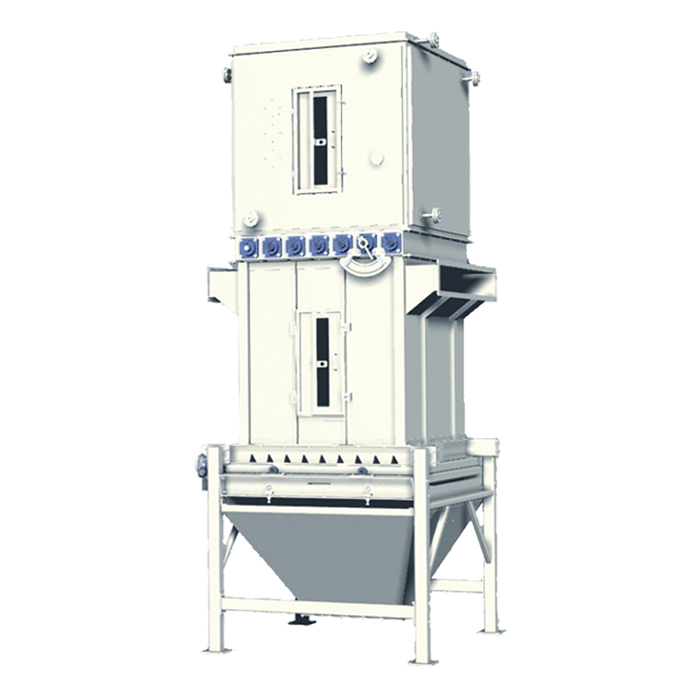
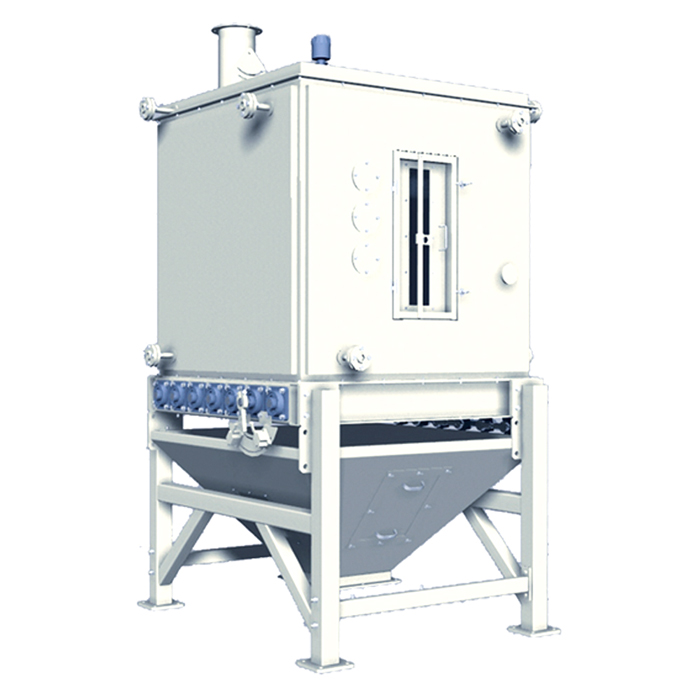
A counterflow cooler reduces the temperature and moisture content of hot pellets discharged from a pellet mill by drawing cool ambient air upward through a bed of pellets that is itself moving slowly downward — hence "counterflow," since the air and the product travel in opposite directions. This arrangement allows the coolest, driest pellets at the bottom of the bed to be cooled by the freshest incoming air, while warmer air rising through the bed pre-conditions the hotter pellets entering at the top.
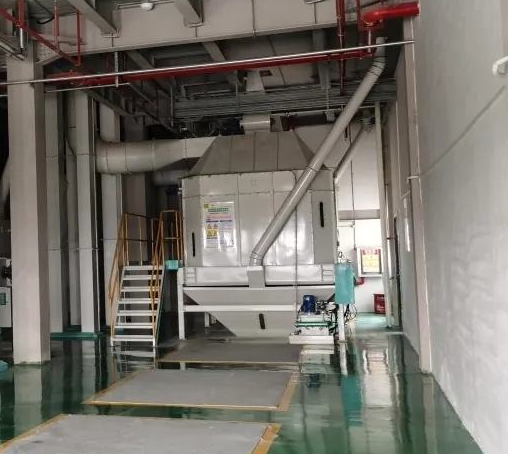
Counterflow coolers are widely regarded as more thermally efficient than horizontal or other cooler designs because the counter-current arrangement maximizes the temperature difference between air and product throughout the cooling process, generally requiring less airflow per tonne of pellets cooled to achieve the same temperature reduction.
The cooler is typically fed from above via a distribution mechanism designed to spread incoming hot pellets evenly across the full cross-section of the cooling chamber, since uneven distribution leads to some columns of pellets being over-cooled while others are under-cooled, reducing overall cooling uniformity even if average performance across the whole cooler appears acceptable.
Residence time within the cooler — controlled by the rate at which the discharge mechanism releases pellets from the base of the bed — is a key variable affecting both cooling performance and pellet durability, since pellets that are discharged too quickly may not be adequately cooled and dried, while excessive residence time can reduce throughput unnecessarily without providing meaningful additional cooling benefit beyond a certain point.
Discharge mechanisms vary by manufacturer but commonly include a rotating or reciprocating grid or paddle system at the base of the cooling column, designed to release pellets at a controlled, even rate across the full bed cross-section rather than allowing material to funnel preferentially through the center, which would create uneven residence time and inconsistent cooling across the discharge.
Air distribution within the cooler housing, along with bed depth and the cross-sectional area of the cooling column relative to throughput, are the main design parameters a cooler manufacturer adjusts when sizing equipment for a specific feed mill's production rate and pellet specifications, with larger pellets generally requiring greater bed depth or longer residence time to achieve the same degree of core cooling as smaller-diameter pellets.

 Jiaozuo City, China

 Bandırma, Turkey