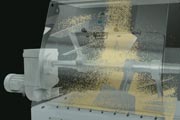
A premix blender is a specialized mixer designed specifically for combining small quantities of concentrated micro-ingredients — vitamins, trace minerals, amino acids and other additives — into a uniform premix, before that premix is itself added as a single ingredient during the main batching and mixing stage of feed production. Premix blenders are distinct from general-purpose feed mixers in that they are typically sized for much smaller batch volumes and built to achieve a higher degree of mixing uniformity than a standard feed mixer would need to deliver.
Because the ingredients combined in a premix blender are often potent, low-inclusion-rate materials where even small mixing errors translate into significant relative dosing inaccuracy in the finished feed, premix blenders are generally designed with proportionally longer mixing times and sometimes more sophisticated internal agitation than bulk feed mixers handling the same total ingredient mass.
Common premix blender designs include ribbon blenders, paddle blenders and some specialized vertical or planetary mixing designs, with paddle and ribbon designs being especially common given their proven ability to achieve low coefficient of variation results even at the relatively small batch sizes typical of premix production.
Cross-contamination control is a particularly significant concern in premix blending, since many premix facilities produce multiple distinct premix formulations — including, in some cases, medicated and non-medicated premixes — using the same equipment, making thorough cleanout procedures between batches essential to avoid carryover of an active ingredient into a premix where it does not belong.
Premix blenders are frequently operated as a discrete, separately managed production area within a larger feed mill, or even as standalone premix manufacturing facilities supplying multiple feed mills, reflecting the specialized quality control, traceability and contamination-prevention requirements that differ somewhat from bulk feed mixing.
Batch verification through coefficient of variation (CV%) testing is generally even more rigorously applied to premix blending than to standard feed mixing, given the consequences of poor uniformity at this concentrated stage of production — an error here is magnified rather than diluted by the time it reaches the finished feed, unlike an error introduced at the main mixing stage which is already diluted across the full batch.