Gelatinization of starch is the physical and chemical transformation that occurs when starch granules in feed ingredients are exposed to sufficient heat and moisture, causing the granules to absorb water, swell and lose their crystalline structure, ultimately improving the starch's digestibility and contributing significantly to the binding properties that hold a pellet together. This transformation is one of the central reasons steam conditioning and, where used, expansion or extrusion are applied before pelleting.
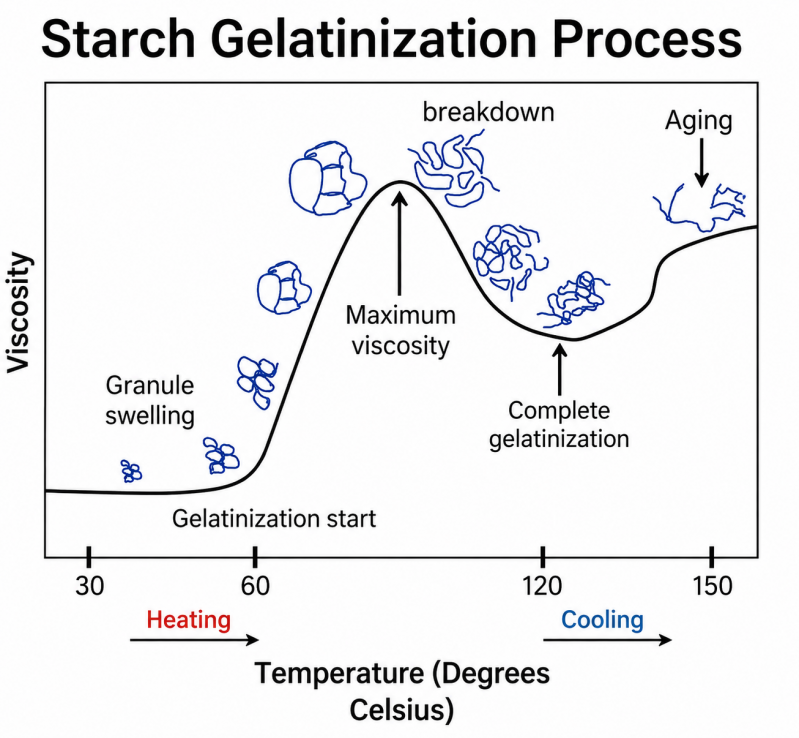
The degree of starch gelatinization achieved during processing depends on the combination of temperature, moisture and residence time the mash is exposed to, with higher conditioning temperatures and longer residence times generally producing a greater degree of gelatinization, up to a point where excessive heat can begin to cause other undesirable effects such as nutrient degradation.
Gelatinization temperature varies by starch source — corn, wheat, and other common feed starches each gelatinize within somewhat different temperature ranges, meaning that a conditioning regime well suited to maximizing gelatinization in one formulation may need adjustment when the starch source composition of a different formulation changes significantly.
The degree of gelatinization achieved can be assessed in a feed laboratory using enzymatic or chemical test methods that measure the proportion of starch converted from its native crystalline form to the gelatinized state, providing an objective, quantifiable measure that complements the more indirect quality indicators (such as PDI or pellet hardness) that gelatinization ultimately influences.
In monogastric animal feeds particularly — poultry, swine, fish and pet food — a higher degree of starch gelatinization is often associated with improved feed conversion and digestibility, which is one reason processes like expansion and extrusion that achieve a higher cook than simple steam conditioning are widely used in aquafeed, pet food and some young animal feed production.
Because gelatinization is fundamentally a heat-and-moisture-driven transformation, it interacts closely with other processing decisions throughout the mill — finer grinding, for example, increases the surface area of starch granules exposed to steam during conditioning, generally allowing a greater degree of gelatinization to be achieved at a given conditioning temperature and time compared to coarser-ground material processed under identical conditioning parameters.


 Crawfordsville, United States of America
 Shang hai, China