Sanitation, in the context of feed mill clean-out procedures, refers to the systematic cleaning of equipment, conveying systems and storage areas to remove residual feed material, prevent cross-contamination between different formulations, and control microbial, pest and other hygiene risks throughout the facility. Clean-out procedures range from routine daily housekeeping tasks to more thorough, scheduled deep-cleaning of specific equipment or production lines.
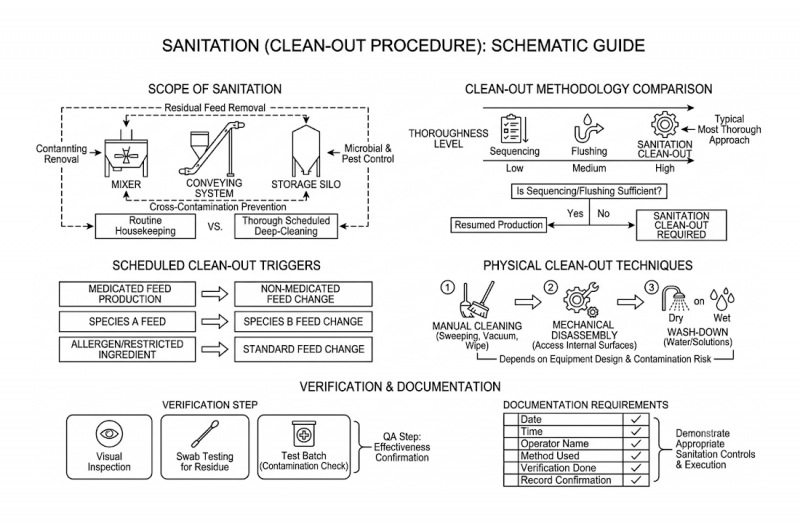
Sequencing, flushing and physical clean-out are the three primary techniques used to manage residual material and prevent carryover between production batches, with sanitation clean-out procedures typically representing the most thorough of these three approaches, generally reserved for situations where sequencing and flushing alone are judged insufficient to adequately address contamination risk.
Scheduled sanitation clean-outs are commonly planned around production changeovers between substantially different formulations — particularly between medicated and non-medicated feed, between feed for different species with different ingredient restrictions, or after producing a formulation containing an allergen or other ingredient requiring strict segregation from subsequent production.
Physical clean-out procedures typically involve a combination of manual cleaning (sweeping, vacuuming or wiping accessible surfaces), mechanical disassembly of equipment access points to reach internal surfaces not otherwise visible or reachable, and in some cases wash-down using water or appropriate cleaning solutions, with the specific combination of methods depending on the equipment design and the nature of the contamination risk being addressed.
Verification that a sanitation clean-out has been effective — rather than simply assuming a documented procedure was followed correctly — is an important quality assurance step, sometimes performed through visual inspection, swab testing for residue, or in some cases running a test batch and checking it for evidence of contamination from the previous product before resuming normal production.
Sanitation procedures and their verification are typically documented as part of a feed mill's overall quality and food safety program, with records demonstrating not just that cleaning occurred but when, by whom, using what method, and how effectiveness was confirmed — documentation that becomes particularly important if a contamination issue is later identified and the mill needs to demonstrate that appropriate sanitation controls were in place and properly executed.