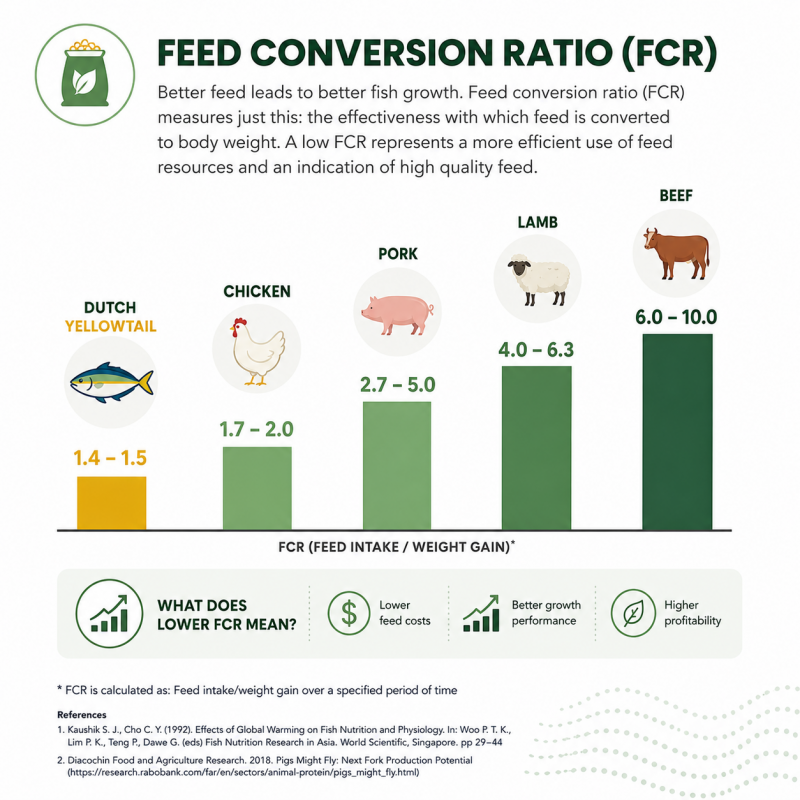
Feed conversion ratio (FCR) is a measure of feeding efficiency calculated as the quantity of feed consumed divided by the corresponding weight gain achieved by the animal, with a lower FCR value indicating that less feed was required to produce each unit of weight gain — generally regarded as more efficient and economically favorable feeding performance. FCR is one of the most widely tracked performance metrics across livestock, poultry and aquaculture production, since feed typically represents the largest single cost component in animal production.
While FCR is fundamentally a nutritional and animal performance metric rather than a feed milling process measurement, it is directly influenced by feed manufacturing quality: pellet durability, particle size, the degree of starch gelatinization achieved during conditioning, and overall nutrient retention through processing can all measurably affect how efficiently animals convert a given feed formulation into growth, even when the underlying formulation itself remains unchanged.
Pellet quality in particular has a well-documented relationship with FCR in many species — feed delivered as intact, durable pellets is generally associated with better FCR than the same formulation delivered with a high proportion of fines, since animals consuming fines alongside intact pellets often show reduced feed intake efficiency and increased feed wastage compared to consuming a more uniform, intact pellet product.
Because FCR integrates the combined effects of formulation, feed manufacturing quality, animal health, environment and management practices, isolating the specific contribution of feed milling process changes to an observed FCR shift can be challenging in practice, and many feed mills work closely with nutritionists and production managers to interpret FCR trends in the context of all these contributing factors rather than attributing changes to feed processing alone.
FCR targets and typical achievable values vary enormously by species, production system and growth stage — broiler poultry production, for example, typically targets FCR values considerably different from those expected in beef cattle finishing, reflecting fundamental biological differences in growth efficiency between species, which means FCR figures are generally only meaningfully compared within the same species and production system rather than across different types of animal production.
From a feed mill's perspective, demonstrating that consistent, high-quality feed manufacturing supports favorable FCR outcomes for customers is often an important commercial consideration, making FCR data — where available from customers willing to share production results — a valuable feedback loop connecting milling process decisions back to the ultimate animal performance outcome those decisions are intended to support.