Energy consumption, commonly expressed as kilowatt-hours per tonne (kWh/ton) of feed produced, is a key operating cost and efficiency metric tracked across feed mills, encompassing the electrical and thermal energy used throughout the production process — grinding, mixing, conditioning, pelleting, cooling and material handling all contribute to a mill's total energy footprint.
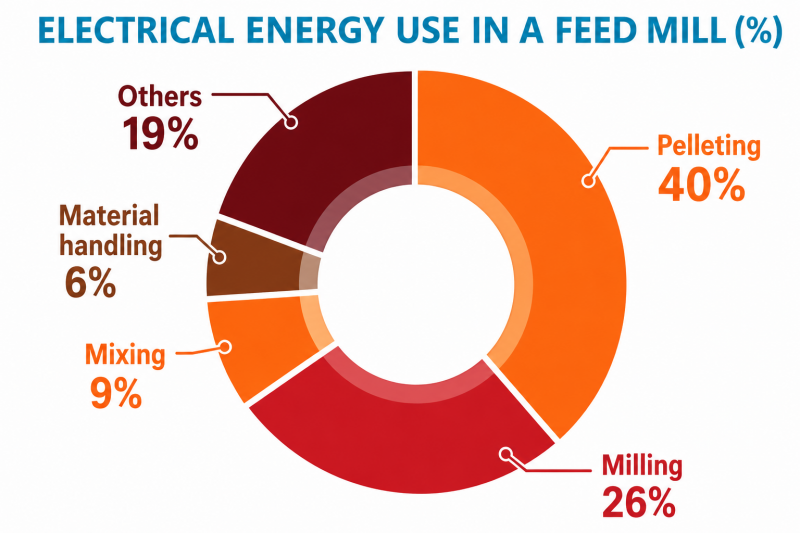
Because grinding and pelleting are typically the most energy-intensive individual processes in a feed mill, energy consumption figures are often broken down by process stage to identify where the greatest opportunities for efficiency improvement exist, whether through equipment upgrades, formulation adjustments or operational changes such as optimized particle size targets or conditioning parameters.
Total energy consumption figures typically combine electrical energy (powering motors throughout the plant) with thermal energy (primarily steam generation for conditioning, and any direct-fired drying if used), and meaningful benchmarking generally requires tracking both components, since a mill that appears efficient on electrical consumption alone might be using disproportionately more thermal energy, or vice versa, masking an overall efficiency picture if only one energy form is monitored.
Production mix has a substantial effect on overall plant energy consumption per tonne, since different products place very different demands on the mill — a fine-ground, heavily conditioned, high-durability pellet product will generally require considerably more energy per tonne than a coarser, less intensively processed mash product, making like-for-like comparison between mills or time periods important when interpreting energy consumption trends.
Benchmarking kWh/ton across similar feed mills, or tracking a single mill's energy consumption over time, helps operators identify when equipment performance is degrading — rising energy consumption for the same product mix can indicate developing mechanical issues such as worn hammers, screens, dies or rolls well before those issues become severe enough to affect product quality.
Some feed mills have invested in sub-metering individual process areas or even individual major equipment items, allowing much more granular energy tracking than a single whole-plant figure can provide, which makes it considerably easier to attribute a change in overall energy consumption to a specific cause — a particular piece of equipment, a particular product line, or a particular shift or operating practice — rather than relying solely on aggregate plant-level data.