Screening (or sieving) as an operational stage in feed manufacturing separates a product stream into different particle size fractions by passing it over or through one or more screens with specific opening sizes, retaining oversize material while allowing properly sized material to pass through. Screening is used at multiple points in feed production, including after grinding to remove any oversize particles, after pelleting or crumbling to remove fines, and during cleaning of incoming raw ingredients to remove foreign material.
In finished feed production, screening after the cooler is commonly used to separate fine material (dust and pellet fragments) from intact, correctly sized pellets or crumbles before the product proceeds to bagging or bulk loadout, with the removed fines typically returned to the production process rather than discarded, to avoid product loss.
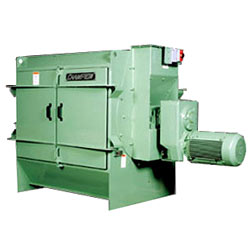
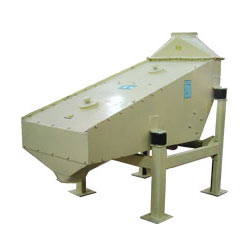
Screening equipment commonly used in this role includes vibrating or oscillating screen decks, which use mechanical vibration to encourage material movement across the screen surface and improve separation efficiency compared to relying on gravity flow alone over a stationary screen, particularly important for materials that do not flow freely or that tend to blind (clog) screen openings if not kept in motion.
Screen blinding — where screen openings become clogged with material that should otherwise pass through, reducing effective screening capacity — is a common operational issue, particularly with sticky, oily or fine cohesive materials, and many screening installations incorporate ball trays, brushes or other screen-cleaning mechanisms beneath the screen deck specifically to dislodge material caught in the openings and maintain screening efficiency over extended operation.
Screen condition, mesh size selection and screening equipment throughput capacity all affect screening efficiency; a poorly performing screening operation can either allow excessive fines through into finished product (reducing apparent quality) or generate excessive recycled material that overloads upstream processes if not properly balanced against production rate.
Screening capacity must be matched to the throughput of the overall production line it serves, since an undersized screening operation becomes a production bottleneck regardless of how well the upstream pelleting or crumbling operation is performing, making screening equipment sizing an integrated part of overall line design rather than an afterthought added once upstream capacity has already been determined.

 Crawfordsville, United States of America
 Foshan, China