Quality control (QC) in feed manufacturing encompasses the overall program of sampling, testing, inspection and verification activities used to confirm that ingredients, in-process material and finished feed products meet specified quality, safety and regulatory requirements throughout production. While specific QC tests — moisture content, particle size, pellet durability, mixing uniformity and others — are each individually significant quality measurements, QC sampling as a broader concept refers to the systematic program governing when, how and how often these tests are performed.
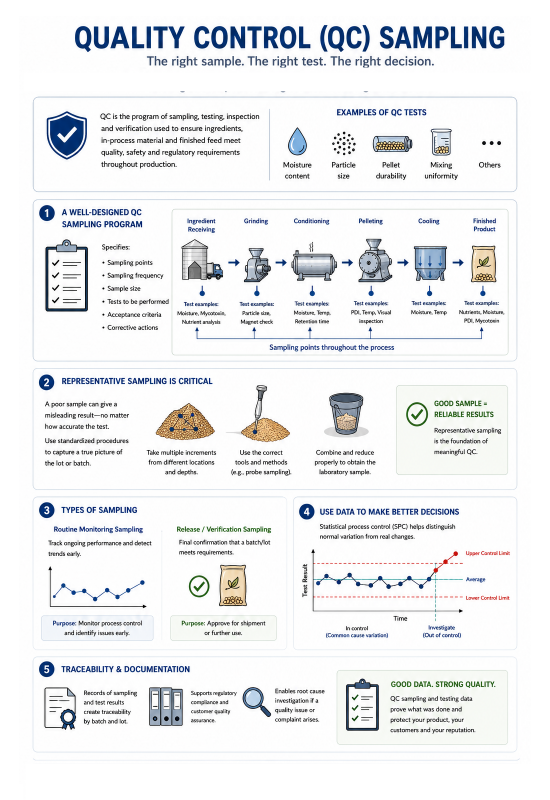
A well-designed QC sampling program typically specifies sampling points throughout the production process — at ingredient receiving, at key intermediate processing stages, and on finished product — along with sampling frequency, sample size, the specific tests to be performed at each point, and acceptance criteria defining what test results are considered satisfactory versus requiring corrective action.
Representative sampling technique is fundamental to meaningful QC results: a sample that does not accurately represent the larger batch or lot it is drawn from will produce test results that may not reflect the true quality of the material being assessed, regardless of how precise or sophisticated the subsequent laboratory testing method is — this is why standardized sampling procedures (such as probe sampling at multiple points and depths) are emphasized as much as the testing methods themselves.
QC programs typically distinguish between routine monitoring sampling, intended to track ongoing process performance and catch developing trends before they become serious problems, and release or verification sampling, intended to provide a final confirmation that a specific batch or lot meets requirements before it is approved for shipment or further use — both serve important but somewhat different purposes within an overall quality program.
Statistical process control concepts are increasingly applied within feed mill QC programs, using accumulated test result data over time to distinguish between normal, expected variation in a stable, well-controlled process versus a genuine shift or trend indicating that something in the underlying process has changed and warrants investigation, rather than reacting individually to every single test result in isolation.
QC sampling and testing data also forms an essential part of the traceability and documentation infrastructure supporting regulatory compliance, customer quality assurance requirements, and — should a quality issue or complaint ever arise — the mill's ability to investigate root cause and demonstrate what quality verification activities were actually performed on the specific batch or ingredient lot in question.