Formulation is the process of determining the precise combination and proportion of ingredients to include in a feed product, designed to meet the target animal's nutritional requirements while satisfying any other constraints such as ingredient availability, regulatory limits, palatability considerations and cost. Least-cost formulation specifically refers to using mathematical optimization techniques — typically linear or non-linear programming — to identify the lowest-cost ingredient combination that still satisfies all required nutritional and other constraints.
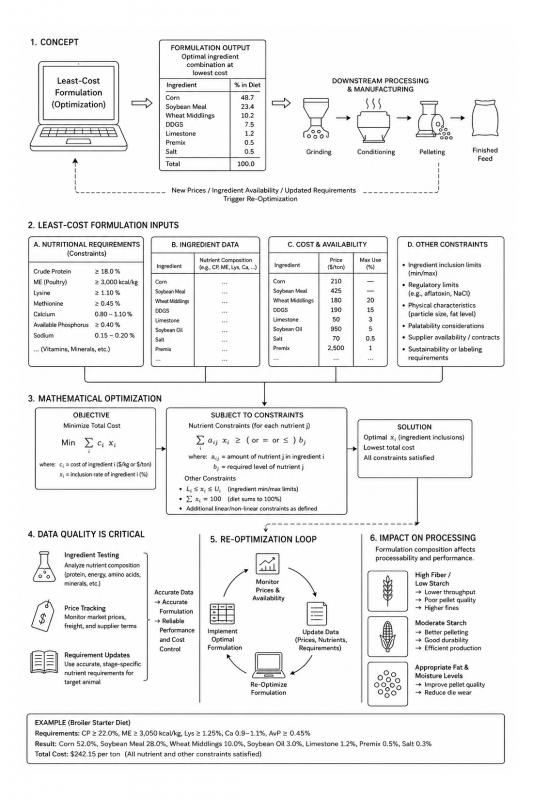
Formulation sits conceptually upstream of nearly everything else covered elsewhere in feed manufacturing: grinding, conditioning, pelleting and every other processing decision are all applied to whatever ingredient combination the formulation specifies, making formulation arguably the single most foundational decision-making process in the entire feed production chain, even though it is primarily a nutritional and economic exercise rather than a physical manufacturing operation in itself.
Least-cost formulation software allows nutritionists and formulators to specify nutrient requirements (protein, energy, specific amino acids, minerals and vitamins, among others) as constraints, along with available ingredients and their current prices and nutrient compositions, with the software then mathematically solving for the ingredient combination that meets all specified constraints at the lowest possible total ingredient cost.
Because ingredient prices and availability fluctuate — sometimes significantly and frequently in volatile commodity markets — formulations are typically re-optimized regularly, sometimes as often as daily in larger commercial operations, allowing feed mills to take advantage of favorable ingredient pricing or substitute alternative ingredients as availability and relative cost shift, while still meeting the same underlying nutritional targets.
Formulation decisions have direct practical consequences for downstream processing: a formulation higher in fiber or lower in starch, for example, may present greater pelleting challenges than a more starch-rich alternative formulation meeting similar nutritional targets, meaning formulators and production staff often need to communicate about the practical processability of candidate formulations, not just their nutritional adequacy and cost.
Formulation accuracy depends entirely on accurate underlying data — correct nutrient composition values for each available ingredient, accurate ingredient pricing, and correctly specified nutritional requirements for the target animal and production stage — making ingredient testing, price tracking and nutritional requirement updates an essential, ongoing support function underlying the formulation process, rather than formulation being a purely computational exercise disconnected from real-world data quality.