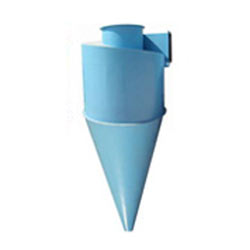
A cyclone separator removes solid particles — typically dust, fines or fine meal — from an air stream using centrifugal force, without any moving parts. Dust-laden air enters the cyclone tangentially near the top of a cone-shaped body, spiraling downward; the heavier particles are flung outward against the cyclone wall by centrifugal force and slide down to be collected at the base, while the cleaned air exits upward through a central outlet.
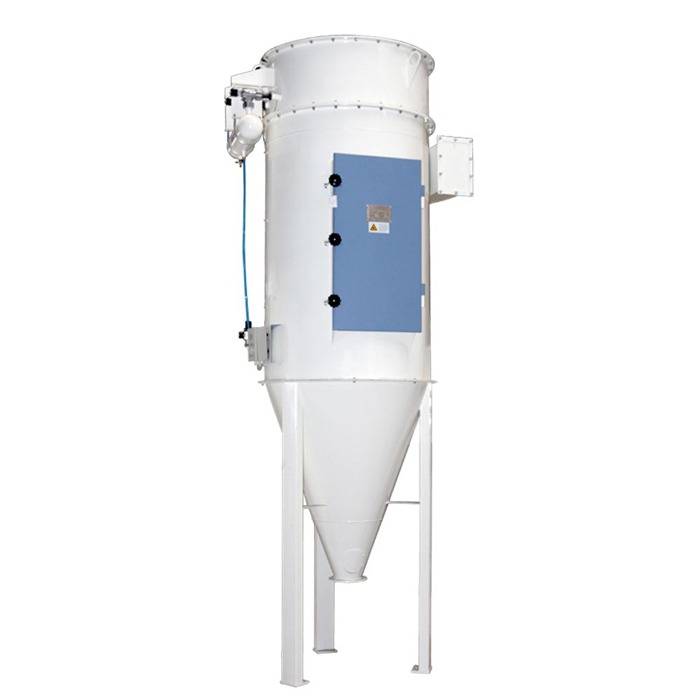
In feed mills, cyclones are widely used as a first stage of air pollution control on pneumatic conveying systems, grinding and pelleting lines, and dust extraction systems, often positioned upstream of a finer bag filter system to remove the bulk of coarse material before the air reaches more delicate filtration media.
Beyond air pollution control, cyclones are also commonly used as the primary receiving and disengagement point at the end of a pneumatic conveying line, separating the conveyed product from the airstream that carried it, with the cleaned product dropping out through a discharge valve (often a rotary airlock) at the cyclone base while the air continues onward, typically to a bag filter for final cleaning before exhaust.
Cyclone efficiency depends on its dimensions, the inlet air velocity, and the particle size distribution of the dust being separated — finer particles are inherently harder to remove by centrifugal force alone, which is why cyclones are typically paired with downstream bag filters rather than used as a sole means of air cleaning where strict emission limits apply.
Because cyclones have no moving parts, they are generally low-maintenance compared to other separation equipment, but they are not immune to operational issues: a partially blocked discharge at the base can cause material to back up inside the cone, reducing separation efficiency and potentially leading to material carryover into the downstream filter system, where it does not belong and can overload filter media intended only for fine dust.
Cyclone sizing is typically specified by the equipment supplier based on the air volume to be handled and the desired separation efficiency for the expected particle size range, and undersized or oversized cyclones relative to actual airflow can both reduce performance — too small a cyclone for the airflow increases pressure drop excessively, while too large a cyclone for the airflow reduces the air velocity needed to achieve good centrifugal separation.

 Yangzhou, China
 Bandırma, Turkey